

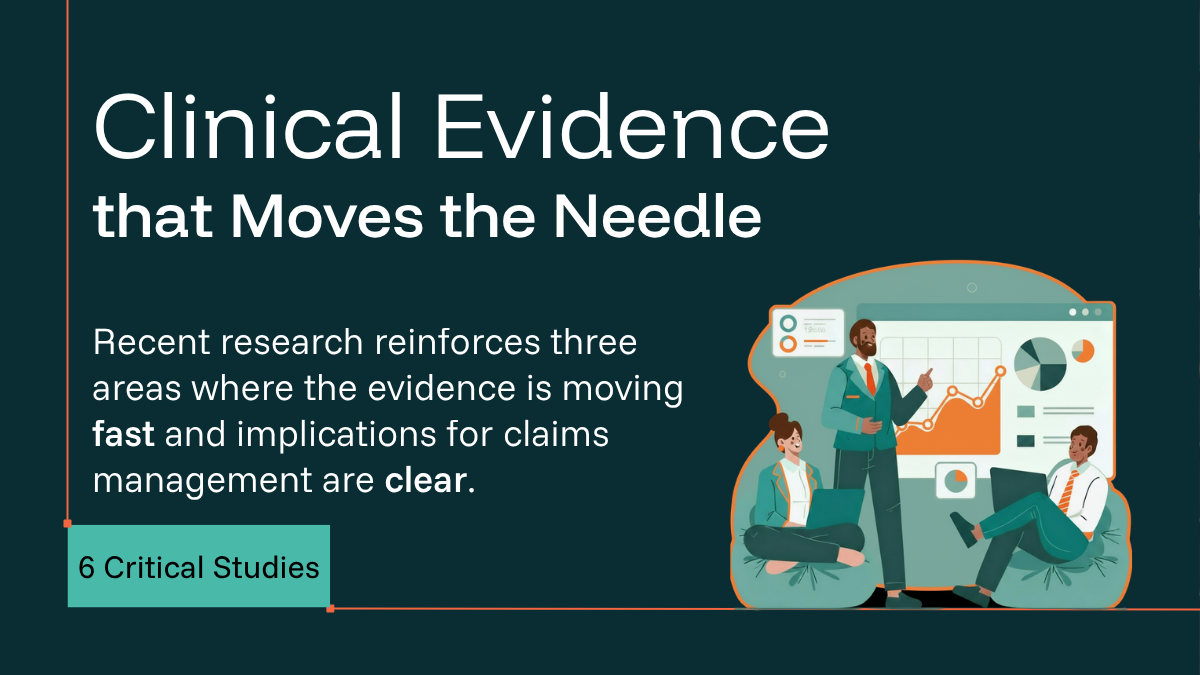
Recent research reinforces three areas where implications for claims management are clear.
RTW & Recovery
New evidence on how opioid use before spine surgery cuts return-to-work odds in half; why early physical therapy and biopsychosocial care outperform early opioids; what drives RTW timelines; and how workplace social support determines whether recovery sticks.
Utilization & Cost
How patterns of early service use predict downstream disability and spend; why opioid prescribing in the first weeks after injury has outsized effects on both return-to-work rates and workers’ compensation expenditures.
Policy & System Design
What happens to workers after claims close and why it’s often not what the file suggests; global perspectives on access, liability, and equity in WC systems; and why provider training in navigating return to work is underutilized and undervalued.
These signals point in a clear direction but understanding how they translate into claim decisions requires a closer look at the data behind them.
Source: Spine surgeon practice variation study (PMC10849168)
79% of injured workers successfully returned to work after treatment for work-related injuries.
CLINICAL SUMMARY
Among spine surgeons treating similar lumbar conditions, use of instrumented fusion ranged from 0% to over 90%. These differences were associated with meaningful variation in major in-hospital complications and 30-day readmissions. Training and higher operative volume were linked to lower complication rates.
What It Means For You
The same diagnosis can lead to very different surgeries depending on the surgeon. When fusion rates vary from almost never to almost always, claim outcomes will vary too. Referral strategy and surgeon performance matter because surgical choice directly affects recovery time, complication risk, and total spend.
$116K-$129K average total medical cost – 43-55 weeks average disability duration.
CLINICAL SUMMARY
Rates of major joint replacement surgeries per 1,000 lost-time claims have increased over time. These claims often exceed $116,000 to $129,000 in total medical costs and are associated with temporary disability of roughly 43 to 55 weeks.
What It Means For You
Joint replacements represent some of the highest-cost, longest-duration claims in the system. As utilization grows, ensuring appropriate patient selection and strong conservative pathways becomes essential to managing both recovery and portfolio risk.
Preoperative opioid users had ~half the odds of stable return to work after spinal surgery.
CLINICAL SUMMARY
Workers’ compensation patients using opioids before spinal surgery had about half the odds of achieving stable return to work compared to non-users.
What It Means For You
Cutting return-to-work odds in half is not a small signal. Preoperative opioid use is a clear risk indicator for extended disability. Early pharmacy oversight and behavioral risk management can materially influence surgical outcomes and claim duration.
Source: JAMA Internal Medicine – Rotator cuff MRI study
99% of adults aged 41-76 had rotator cuff abnormalities on MRI – including those with no pain.
CLINICAL SUMMARY
In adults aged 41 to 76, 99% had at least one rotator cuff abnormality on MRI. Abnormalities were present in 96% of asymptomatic shoulders and 98% of symptomatic shoulders, showing minimal difference between those with and without pain.
What It Means For You
When nearly everyone shows “abnormal” findings, imaging alone cannot define the problem. If structural changes are treated as the cause of pain without clinical context, care can escalate unnecessarily. Functional assessment should guide decisions, not the MRI report alone.
79% of injured workers successfully returned to work.
CLINICAL SUMMARY
Across studies, specific outcomes for injured workers varied based on factors such as age, education level, and injury type.
What It Means For You
The majority of workers do get back to work, which is encouraging. The opportunity lies in identifying the roughly 1 in 5 who may struggle and intervening early with targeted support before disability becomes prolonged.
A systematic scoping review found that injured workers are generally disadvantaged in some manner following claim finalization.
CLINICAL SUMMARY
Research consistently shows that many injured workers experience ongoing financial, vocational, and psychosocial challenges even after their workers’ compensation claim is finalized.
What It Means For You
Administrative resolution does not always equal durable recovery. If recovery stability is not supported at transition, downstream risks such as re-entry, dissatisfaction, or litigation may follow. Long-term outcomes matter beyond the claim file.
What the Evidence Tells Us
Across these studies, a consistent signal emerges: early clinical interpretation, not late utilization management, determines claim trajectory. The evidence does not point to radical change. It points to disciplined execution of what works.
- Early insight.
- Appropriate utilization
- Thoughtful intervention
When those three things operate together, recovery improves and total claim trajectory stabilizes.
These studies only tell a part of the story. The full 2026 Trends Report connects the dots, revealing where all of workers’ comp is headed and how decisions made today shape recovery tomorrow.